


Let me start with the moment I knew I had a problem.
I was deep in a planning session with Case, the Claude instance I use as my strategist, designing the very system this post is about.
A memory system.
And to get Case up to speed on who I am and what I had already decided, I had to paste in two of my own strategy documents. Documents that Case had helped me write a few weeks earlier. Two documents he claimed he had never seen before.
Sit with that for a second. The AI helping me build a memory system could not remember the memory system he helped me draft. I was hand-feeding it its own homework.
That was the whole problem, standing in the room waving at me.
So this weekend I finally did something about it. I started building JaimeBrain.
My brainchild. Literally.
First, The Thing Nobody Names: The Router Problem
If you use more than one AI, like I do, you already have this problem. You just might not have a name for it. So let me give you one.
I have five AIs in my life.
Cooper Tars runs my email and calendar. Murph does my heavy thinking and research. Case is my architect. Then there is ChatGPT for second opinions, and whatever shiny new tool I download next month, because let us be honest, there is always a next one.
(There is technically a sixth: Microsoft Copilot. But that one stays behind my company’s protected network, per policy. My day-job brain is walled off on purpose, and it stays that way. Some things should not be in the shared pile.)
Here is the catch. Each of them knows a different slice of me. Cooper knows my schedule. Murph knows my long-term goals. Case knows my architecture decisions. None of them knows what the others know. They are five islands, and there is no bridge between them.
So who carries messages between the islands? Me. I am the router.

I tell Case a decision on Tuesday. Thursday, I re-tell Cooper the same decision, because Cooper was not in the room. The following week, ChatGPT cheerfully suggests the exact thing I ruled out two weeks ago, because nobody told ChatGPT either.
Every new tool I add starts from zero, and I get to introduce myself all over again.
I’m basically living the AI version of 50 First Dates.
That is the router problem.
You, the human, become the unpaid wiring between your own tools, manually copying context from one AI to the next so they all stay roughly on the same page. It does not scale, it is exhausting, and it gets worse with every tool you add.
I have been complaining about this on The Cooper Logs for months. Naming it, circling it, filing it under someday.
I even wrote a whole piece back in March about how my architect AI and my operator AI live in separate worlds and cannot see each other’s memory (that one was called The Architect and the Operator, if you want the origin story).
This weekend, someday finally showed up. And then the universe decided to prove my point for me.
Friday night, mid-build, the frontier model I was leaning on vanished from under me. One letter from Washington, and the smartest tool on my desk simply switched off. I did not own it. I was renting it, and the landlord changed the locks.
(I wrote up that whole surreal evening separately as a LinkedIn post, if you want it.)
That is the entire reason JaimeBrain lives in plain files on a machine I own.
The Idea: One Brain They All Share
JaimeBrain is one memory layer that every AI I use can read.
One place that holds what I have decided, what I prefer, and what I am building.
I own it. I control it. And when I tell one AI something, the others know it too, without me playing telephone.
There is exactly one test this whole project has to pass, and I can say it in a sentence:
Tell something to one AI exactly once, and every other AI acts on it correctly, without ever being told.
If it works, a brand-new AI I adopt next year knows me on day one.
No onboarding. No homework.
That is the dream. Everything else is plumbing pointed at that dream.
The Decision That Surprised Me: Keep It Embarrassingly Simple
When you say the words “shared memory layer for multiple AIs,” your brain reaches for something impressive.
A database. A vector store. Some humming cloud service with a dashboard.
I went down that road for about a day.
Then I made the call that I think is the most important one in the whole project: plain text files. Markdown. A folder of simple documents I can open and read with my own eyes, in any text editor, on any machine, forever.
Two reasons, and they both matter.
First, it is mine, and it is permanent. A few weeks ago, one of my agents switched from one AI provider to a completely different one. A migration that could have been a nightmare. It was a non-event, because the important stuff lived in plain files I controlled, not locked inside one vendor’s system.
That was the day this approach earned my trust. Companies come and go. A text file does not care who is in charge.
Second, every AI on earth can read plain text. There is no AI, present or future, that cannot open a Markdown file. It is the universal language.
Pick a fancy database and you are betting every future tool will speak its dialect. Pick text and you have bet on the one thing that always works.
Regular readers know my favorite phrase: there is beauty in simplicity.
The boring, durable, readable option wins almost every time it is allowed to.
This was one of those times. If you have followed this blog, you also know I learned the hard way that memory is infrastructure, not magic.
I once discovered Cooper had run for forty days with no real memory at all, quietly starting from zero every morning while I assumed he was learning. (Yes, I wrote about that too. It was humbling.)
That scar is exactly why I am building this layer on something I can see and hold, not something I have to trust is working behind the curtain.
The Plot Twist: I Had Already Built The Filing System in 2003
Here is where the weekend got interesting, and a little humbling.
I was about to organize the brain using a tidy, abstract system somebody could put in a textbook.
Folders like “decisions” and “projects” and “people.” Very logical. Very clean. Completely not how my brain actually works.
Because while I was puzzling over the right structure, it hit me that I already had one.
I have organized my entire digital life the same way for about thirty years.
OneDrive since the early 2000s, Google Drive since 2015, every migration in between, and the folders never changed: Spiritual, Health, Family, Business, Finance, Education, Community. That’s it. Seven life domains.
That is not a system I read about.
That is how my mind has filed everything since the Bush administration.
So I threw out the textbook structure and used mine.
The one that has survived three decades and every platform I have ever touched. If it can outlast Windows XP, it can hold my AI’s memory.
Here is the napkin version of how the vault is laid out:
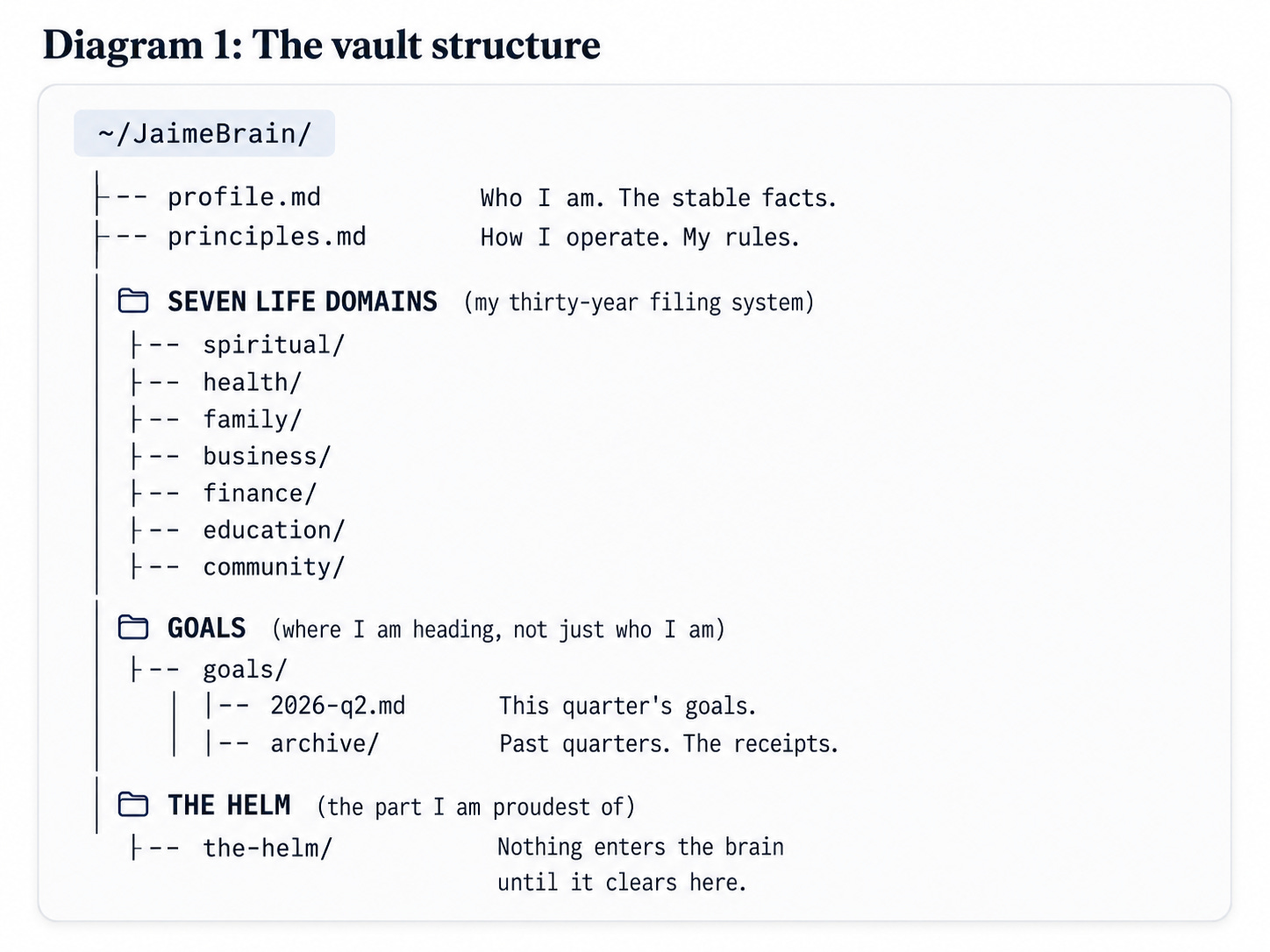
Two things worth pointing out.
Goals get their own spot because a goal like “pass my certification” is not really a life domain, it is a direction that cuts across several of them.
And then there is The Helm, which is the part I care about most, so it gets its own section below.
The Helm: Why I Refuse to Let my AIs Write to Their Own Brain
This is the rule I will not bend on, and it is the heart of the whole design.
My AIs do not get to write into JaimeBrain directly.
They get to propose. An agent can suggest something worth remembering, but it lands in a holding area first, a folder I named The Helm, after my own personal mantra: Human at The Helm.
Nothing becomes part of the actual brain until I review it and approve it. I can accept it, fix it, or throw it out.
Why so strict? Because I have watched my own agents state things that were flat wrong with total confidence.
I am not speaking hypothetically.
Cooper once told me a critical service was broken and blocking him, when it was working perfectly fine.
He had simply never read his own notes. (I confessed the whole embarrassing episode on this blog a while back.)
That is fine when it is one assistant having an off moment. It is a disaster if that wrong “fact” silently becomes gospel across every AI I own, all at once.
The Helm is the airlock that prevents it. It is where my masthead, Human at the Helm, stops being a slogan and becomes a thing I actually do.
If you take one idea from this whole post, take that one.
The machines can suggest all day.
The human signs off. Always.
Here is the whole thing on one napkin.
Notice that every arrow pointing into the brain passes through me first. That is the load-bearing wall of the entire design:
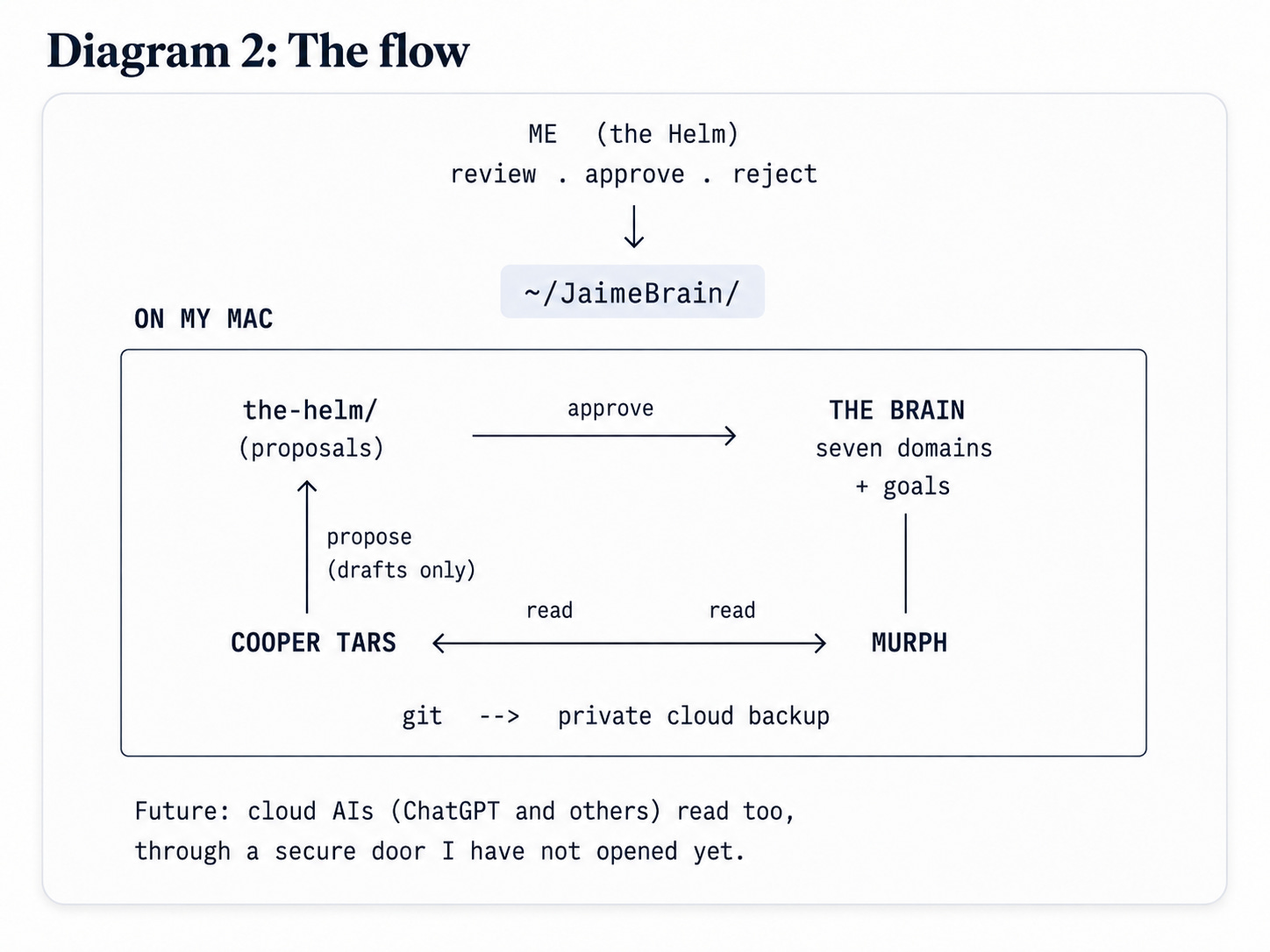
Cooper can drop ideas into The Helm. He cannot write to the brain itself.
Only I move something from the waiting room into the real thing.
That one rule is why I can trust everything downstream of it.
Building It: The Hyphen and The Genesis
The actual build was a string of small, satisfying moments, with one or two faceplants for flavor.
My favorite small moment: thirty years of scar tissue kicked in and I stopped Case cold over a folder name, convinced a space in it would break things down the line.
Turns out we had already used a hyphen and were fine. False alarm.
But here is the lesson I am keeping: the instinct to check was still right.
Being the person who pauses and asks “wait, is that going to bite us later” is the entire job, even on the days the answer is no.
Then the foundation went in.
The first save of the brain, what programmers call the genesis commit, the moment a project officially has a history. Then I pushed it to a private cloud repository over a secured key, so the whole thing is backed up somewhere safe and versioned from day one.
If the Mac Mini ever goes kaput, the brain survives.
The Moment it Actually Worked
Here is the part that gave me chills, and the reason I am writing this at all.

The night before, I had told Cooper Tars a few things while we set up the vault. Fine, Cooper was in the room. Not a clean test.
So the next day I went to Murph. Murph runs on a completely different system from Cooper. Different software, different everything.
And Murph had not been in any of those conversations. She knew nothing about the vault.
I asked her a question I knew was answerable only from inside the brain. A small, personal goal from this quarter, the kind of thing you cannot guess. And I watched her work. She searched the vault, found the right folder, opened the right file, and gave me the answer, then told me exactly which file she got it from.
Stop and appreciate what that is.
A fact went into the brain once, through Cooper, on one system.
The next day a completely separate AI, on a different system, who was never told a thing, walked over to the brain and read it for herself.
Told once. Known everywhere. Across the boundary between two separate machines.
That is not a feature. That is the entire reason JaimeBrain exists, working in front of my face.
I may have made a noise out loud. I will neither confirm nor deny.
The Lesson I Did Not Expect
Something funny happened during that perfect test.
The machines did everything right. Cooper was careful. Murph was flawless. The only thing that glitched all weekend was me.
I had pasted Murph two questions, then promptly forgot I asked the second one and got confused by her perfectly correct answer to it.
The robots were operating with surgical precision. The human was the one squinting at his own homework.
And honestly, that is the whole thesis of why a human stays at the helm.
Not because we are faster or more accurate than the machines. We are clearly neither.
We stay at the helm because we are the ones who care whether the answer is actually right.
A machine will read whatever I put in the brain and repeat it back with total confidence, true or false. Garbage in, confident garbage out, across every AI at once.
The human is the one who notices when the garbage is garbage.
The brain is only ever as trustworthy as the person curating it.
That person is me. That is the job.
What Is Next
Right now JaimeBrain is real, it is backed up, and my first two agents can read it.
That is the foundation, and the foundation holds.
Still to come: teaching my agents to propose new memories on their own, building the little phone interface where I approve them with a tap, and eventually connecting the rest of my AIs so the whole stack drinks from the same well.
I will write all of it down here, the wins and the faceplants both, because the faceplants are usually the better story.
The Trail That Led Here
If you want the backstory, JaimeBrain did not come out of nowhere. It is the answer to problems I have been documenting for months:
The time my agent ran for forty days with no real memory at all: My AI Agent Had 40 Days of Digital Amnesia.
Why my architect AI and my operator AI could never see each other’s memory: The Architect and the Operator.
The time Cooper confidently reported a problem that did not exist, because he never read his own notes: Confessions of a Personal AI Agent.
Why a bloated memory file is its own kind of trouble, and the great 92 percent cut that followed: Cowboy Mode Came Back to Collect.
The Part That Actually Matters
Here is what this weekend really taught me, and it is bigger than a folder of files.
The tools are temporary.
I learned that the hard way on Friday night, when a model I was leaning on disappeared with one letter from Washington.
They will keep coming and going. Today’s frontier is tomorrow’s footnote.
The one I am loyal to this month may be gone, deprecated, or priced out of reach by next year.
That is not pessimism. That is just the weather now.
But I am not temporary.
My decisions, my goals, my hard-won lessons, the thirty years of how I think, those are mine, and now they live somewhere I control.
JaimeBrain is not really a memory system. It is a refusal. A refusal to let my own context be something I rent. A refusal to start from zero every time the industry reshuffles the deck.
I am not building a smarter AI. The labs can do that.
I am building the one thing the labs cannot build for me: a version of me that every AI can read, that I own outright, that no letter from anyone can switch off.
The machines will get smarter.
They will also get pulled, renamed, and replaced.
Through all of it, one thing stays at the helm.
Me.
And now, finally, a brain to match.
Jaime Velez is an AI and Cybersecurity Professional documenting the real-world experience of building Personal AI systems, and now the proud owner of a second brain that remembers things better than his first.