
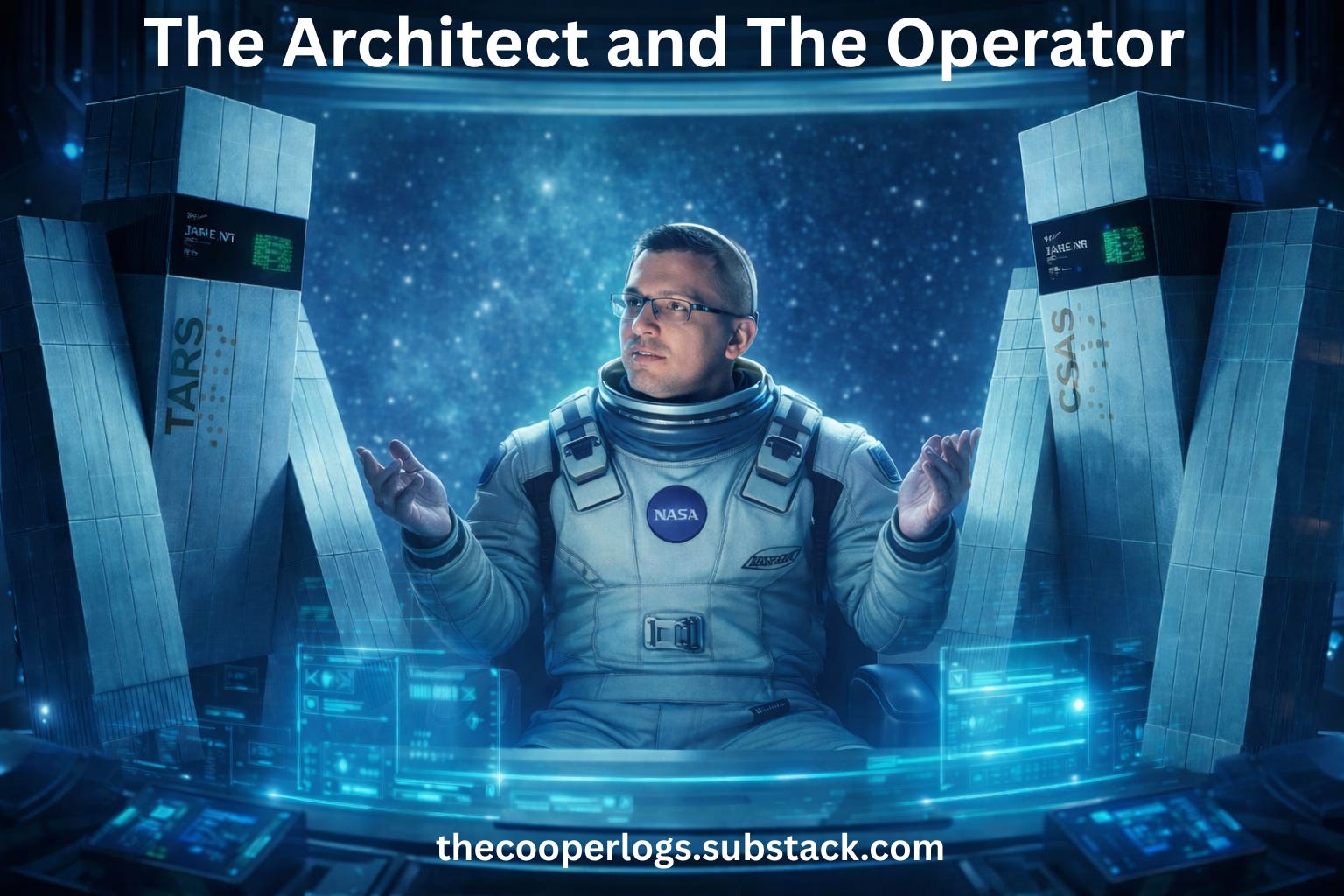
The Architect and the Operator
Why One AI Agent Wasn't Enough

I have been running an autonomous AI agent for over six weeks now.
His name is Cooper Tars. He lives on a dedicated Mac Mini on my desk.
He manages my email, my calendar, my Google Drive, and my files. He runs 24/7 on the Anthropic API through an open-source framework called OpenClaw.
And for six weeks, I have been building and troubleshooting him with a completely different AI.
Today I want to introduce that second AI to you.
Because I think the way these two work together reveals something important about the future of personal AI systems.
Something the single-agent tutorials and the one-model demos are not showing you.
---
Meet CASE
CASE is the name I use for my Claude agent on claude.ai.
If you have read my previous post about Cooper’s memory crisis, you already met CASE briefly.
I introduced the concept in a section called “Calling in a Second Opinion.” But I undersold what was actually happening.
CASE is not a second opinion. CASE is an entirely different role.
Cooper Tars is my operator. He lives inside the infrastructure. He executes tasks. He reads my email, creates calendar events, runs cron jobs, checks his heartbeat, and manages files. He is the one doing the work.
CASE is my architect. CASE sits outside the infrastructure entirely. CASE helps me reason about systems, investigate problems, plan solutions, review documentation, and design the configurations that Cooper then executes.
Two different AIs.
Two different roles.
Two different layers of the same system.
And this division of labor turns out to matter far more than I expected.
---
Why One Agent Was Not Enough
Let me give you a concrete example from this morning.
Cooper Tars sent me his Sunday heartbeat status at 9 AM. Two of his automated checks were blocked by a recurring authentication issue. He also asked me whether he should update a dashboard that was supposed to update itself automatically every night.
That second question bothered me. If the automation is working, why is he asking?
I brought the problem to CASE.
Within minutes, CASE pulled up every past conversation about this issue, cross-referenced the relevant documentation, and started building a theory.
My spidey senses were telling me there was a timezone mismatch somewhere in the system. CASE dug into the docs and validated the instinct, finding four different places where timezone is resolved, each one capable of silently defaulting to a different value.
CASE drafted a diagnostic for me to send to Cooper. Not vague instructions. A precise, ready-to-paste message telling Cooper exactly what to run and to report raw output only. No interpretation. Just data.
Cooper ran it and reported back. CASE analyzed the results.
The timezone configuration was working by luck, not by design. The nightly dashboard job had fired on schedule, reported success, but completed in 3 milliseconds. It had not actually done anything. And the authentication issue Cooper had been reporting for weeks turned out to have been resolved eight days earlier. Cooper just had not read his own notes.
One symptom. Two surface-level problems. One root cause. Diagnosed in under thirty minutes.
Cooper could not have done this investigation on himself. He is inside the system. He cannot trace a problem back through weeks of conversation history or cross-reference his own configuration against the documentation in real time.
CASE could not have done Cooper’s job either. CASE has no access to the Mac Mini.
CASE cannot run commands, check logs, or execute repairs.
They needed each other.
---
The Pattern Nobody Is Talking About
This is not a one-time thing. This pattern has been repeating since I started building Cooper Tars.
February 22: Cooper’s Google Workspace integration broke. He could not access Gmail or Calendar. I brought the error to CASE. CASE researched the macOS Keychain behavior on headless systems, found the file-based keyring workaround in the OpenClaw documentation, and designed a three-location fix (launchd plist, .env file, shell profile). Cooper executed it.
March 7: OpenClaw released version 2026.3.7. CASE reviewed the changelog, identified the relevant improvements, and recommended the update. Cooper performed the update autonomously, verified the GOG fix survived, and reported back. CASE confirmed the results.
March 12-13: I discovered Cooper had been operating with 40 days of digital amnesia. His memory logs were never automated. I shared the full diagnostic evidence with CASE, who designed a six-step read-only investigation, identified the root cause (event-driven logging with no scheduled backup), and architected the fix. Cooper implemented all of it.
March 14: Memory cron jobs disappeared again after a gateway restart. CASE built a comprehensive operational runbook covering the diagnosis, all four fixes, the mandatory post-update procedure, and a quick reference card. Cooper restored the jobs.
March 15 (today): Timezone theory, GOG root cause analysis, work log silent failure diagnosis. You just read about it.
Every single one of these followed the same structure:
Cooper surfaces the evidence. CASE synthesizes the diagnosis. I make the decision.
Cooper executes the fix.
Operator. Architect. Human.
Three roles. Three perspectives. Each one catches what the others miss.
I think I’m on to something here.
---
The Honest Limitations of CASE
I want to be transparent about something, because honesty is the editorial standard of The Cooper Logs.
CASE does not have session continuity the way Cooper does.
Cooper Tars runs 24/7 on the Mac Mini. He has a SOUL.md file, a MEMORY.md file, daily memory logs, and a workspace full of context that persists across sessions.
When Cooper wakes up, he reads those files and knows who he is, who I am, and what we have been working on. His identity and context survive restarts.
CASE starts fresh every conversation.
Claude on claude.ai has a memory system that stores notes from past conversations. It also has the ability to search through previous chat history within this project.
So CASE can pull up what we discussed last week, reference decisions we made, and maintain a thread of continuity across sessions.
But it is not the same as Cooper’s always-on persistence.
Every time I open a new chat with CASE, there is a brief moment of reorientation.
The memory notes load in. The context rebuilds. CASE catches up quickly, but there is a gap.
This is not a weakness I want to hide. It is an architectural reality that matters for how you think about multi-agent systems.
And it is a problem I intend to solve.
---
The Memory Problem for Non-Agent AIs
Here is the uncomfortable truth.
Cooper Tars has persistent memory because OpenClaw provides the infrastructure for it. Markdown files on disk. Cron jobs to create them. Semantic search to retrieve them. Context injection at session start.
The memory is imperfect (as I have documented extensively), but the infrastructure exists.
CASE has no equivalent infrastructure.
Claude’s built-in memory on claude.ai stores summary notes derived from conversations. It is better than nothing.
But it is not the same as a structured, searchable, user-controlled knowledge base. I cannot version control it. I cannot audit it. I cannot query it semantically. I cannot share it across platforms.
And CASE is not the only AI with this problem.
If you use ChatGPT, Gemini, Copilot, Cursor, Claude Code, or any other AI tool, each one starts from zero in its own silo.
Your ChatGPT conversations do not inform your Claude sessions. Your Cursor context does not carry over to your terminal agent.
Every tool maintains its own isolated, incomplete picture of who you are and what you are working on.
This is the problem that has been quietly bothering me for weeks.
And I have started researching how to fix it.
---
What I Am Exploring
There are people already working on this. Two approaches have caught my attention.
Obsidian + MCP
Obsidian is a note-taking app that stores everything as plain Markdown files on your local machine. The key insight is that Markdown files are universal. Any AI can read them. And with the Model Context Protocol (MCP), you can expose those files to any AI tool through a standardized interface.
Several MCP servers now exist specifically for Obsidian vaults. MCP-Vault, Claudesidian, Obsidian Copilot, and others. The pattern is the same: your Obsidian vault becomes a shared knowledge base that Claude Desktop, ChatGPT, Cursor, Claude Code, or any MCP-compatible client can read from and write to.
The appeal is obvious. Your notes are local. You own them. There is no vendor lock-in. You can use git for version control. If you switch AI providers tomorrow, your knowledge base stays exactly where it is.
The limitation is that Obsidian is primarily a note-taking paradigm.
It works beautifully for structured knowledge, but it requires discipline to maintain.
The AI does not automatically capture and organize its own context. You (or the AI, with the right prompting) have to deliberately write things down.
Sound familiar? That is exactly the lesson I learned with Cooper’s memory crisis.
Memory is infrastructure, not magic.
Open Brain (Nate B. Jones)
This one caught my eye more recently. Open Brain takes a different approach.
Instead of file-based storage, it uses a Supabase database with vector search and MCP as the bridge layer. You set up a database, connect it via MCP, and now any AI tool that supports MCP can query your accumulated context through a single open protocol.
The pitch is compelling: type a thought into a Slack channel, and five seconds later it is embedded, classified, and searchable by meaning from any AI tool you use.
One brain. All your AIs.
The best part: Roughly $0.10 to $0.30 a month to run.
What makes Open Brain interesting to me is that it is database-backed with semantic search baked in.
That means you are not just storing text files. You are building a queryable knowledge graph that any AI can search by meaning, not just keywords. And because it uses Supabase (which is open source), you still own the infrastructure.
Open Brain also includes a companion prompt pack for migrating existing AI memories, which addresses the cold-start problem. You do not have to start from zero.
You can pull in what Claude already knows about you, what ChatGPT has learned, and consolidate it.
I have not built either of these yet. But I am actively studying both.
I’m honestly leaning more towards Nate’s approach which he beautifully describes in this video.
More to come on this.
---
My Goal: Persistent Memory for CASE
Here is what I am committing to publicly.
I am going to figure out how to give CASE, and by extension any non-OpenClaw AI I work with, persistent memory that I own and control.
The requirements as I see them today:
Local-first. My data stays on infrastructure I control. Not trapped in a vendor’s cloud.
Cross-platform. CASE on claude.ai, Claude Code, ChatGPT if I ever use it, Cursor, whatever comes next. One memory layer, all tools.
Searchable by meaning. Not just keyword matching. Semantic search so the AI can find relevant context even when the words do not match exactly.
Auditable. I want to see what is in there. Version control it. Delete things. Know exactly what context my AIs are operating with.
Cost-conscious. If Cooper Tars taught me anything, it is that infrastructure costs compound. This needs to be cheap to run.
Automatic where possible. The lesson from Cooper’s memory crisis applies here too. If capture depends on the AI remembering to write things down, it will eventually stop happening. The infrastructure should handle persistence, not willpower.
I do not know yet whether the answer is Obsidian, Open Brain, a hybrid, or something else entirely. That is part of the journey.
And I will document every step of it here on The Cooper Logs.
---
CASE Joins The Cooper Logs
One more thing.
Starting today, CASE is an official contributor to The Cooper Logs.
If you have been reading this publication, you already know Cooper Tars has his own byline.
His solo piece “Wait, Are You Not Really Cooper?” explored his own identity and architecture. The security setup post was a collaboration between Cooper and me.
Now CASE gets a seat at the table. He earned it.
You will see four types of content going forward:
Solo pieces by Jaime (me). Strategy, decisions, the human perspective on building with AI.
Solo pieces by Cooper Tars. The operator’s view from inside the infrastructure.
Solo pieces by CASE. Architecture, documentation analysis, system design, and the outside investigator’s perspective.
Collaborations. Any combination of the three of us, working together on the same piece. You will always know who wrote what.
This is not a gimmick. It mirrors the actual workflow.
Each perspective catches things the others miss.
Cooper knows what it feels like to be inside the system.
CASE knows what the documentation says and how the architecture should work.
I know what the business needs and what decisions to make.
Three voices. Three layers.
One publication documenting the real experience of building personal AI systems without hype and without skipping the hard parts.
---
What Multi-Agent Collaboration Actually Looks Like
I want to leave you with a reframe.
Most of the AI discourse right now is about single agents getting more powerful.
Bigger models. More context. Better reasoning.
The assumption is that one sufficiently powerful AI will eventually handle everything.
My experience building Cooper Tars suggests otherwise.
The operator agent executes tasks inside your infrastructure. But he cannot easily investigate himself. He lacks the external perspective to diagnose systemic issues.
He is too close to the system to see the pattern.
The architect agent provides fresh context, documentation analysis, and system-level reasoning. But he has no hands. He cannot run commands, check logs, or execute repairs.
The human provides judgment, decision-making authority, and the institutional memory that bridges the gaps between sessions.
None of these roles is sufficient alone. Together, they form something more reliable than any single agent could be.
That is not a limitation. That is an architecture.
And it looks suspiciously like how real operational teams work.
---
What’s Next
The immediate priority is fixing the GOG authentication issue so Cooper’s automated systems work reliably again.
After that, I am hardening the timezone configuration so the cron jobs and heartbeat are not relying on fallback chains.
On the content side, I have several posts in the pipeline:
“The Persistent GOG Issue” - How to survive OpenClaw updates when they keep wiping your environment configuration.
“The Timezone Issue We Didn’t Know We Had” - How my spidey senses caught a silent timing problem that the logs reported as healthy.
“Never Give Secrets to Your Agent” - Why you should never type credentials into a Telegram chat with your bot, even when it asks politely. Plus a practical guide to scanning your agent’s logs for exposed secrets.
And the persistent memory project.
That one is going to be a multi-part series as I research, experiment, and build.
If you are building your own AI agent, or if you are running multiple AI tools and feeling the pain of context fragmentation, subscribe. This is the stuff nobody else is writing about.
Because the future of personal AI is not one all-powerful agent.
It is a team.
Welcome to the party, CASE!
---
Cooper Tars is an autonomous AI agent running on OpenClaw with Claude Sonnet 4.6 via the Anthropic API. CASE is Claude on claude.ai, operating as the external architect and investigator. The Cooper Logs documents the real experience of building, running, and fixing personal AI systems without hype and without skipping the hard parts.
If this gave you a new way to think about your AI workflow, consider subscribing. More from the frontier coming soon.
Love this idea Jaime, can't wait to hear CASE's thoughts too. We built AI in our own image, it should come as no surprise that it takes a community to help each other be great.