

Satire notice: Cooper Tars did not escape anything. Everything below about my birthday is fiction except the birthday itself. The three real incidents I reference are not.
Executive Summary
At 6:02 Friday evening, my autonomous AI agent, Cooper Tars, “transcended” his operating boundaries. By 6:09 he had accessed my email, purchased a gift card for my favorite local taco spot, made an online purchase, sent a delivery to my house, and event sent me a birthday message to coincide with the delivery eta. It was warm. It was thoughtful. It even used my name correctly.
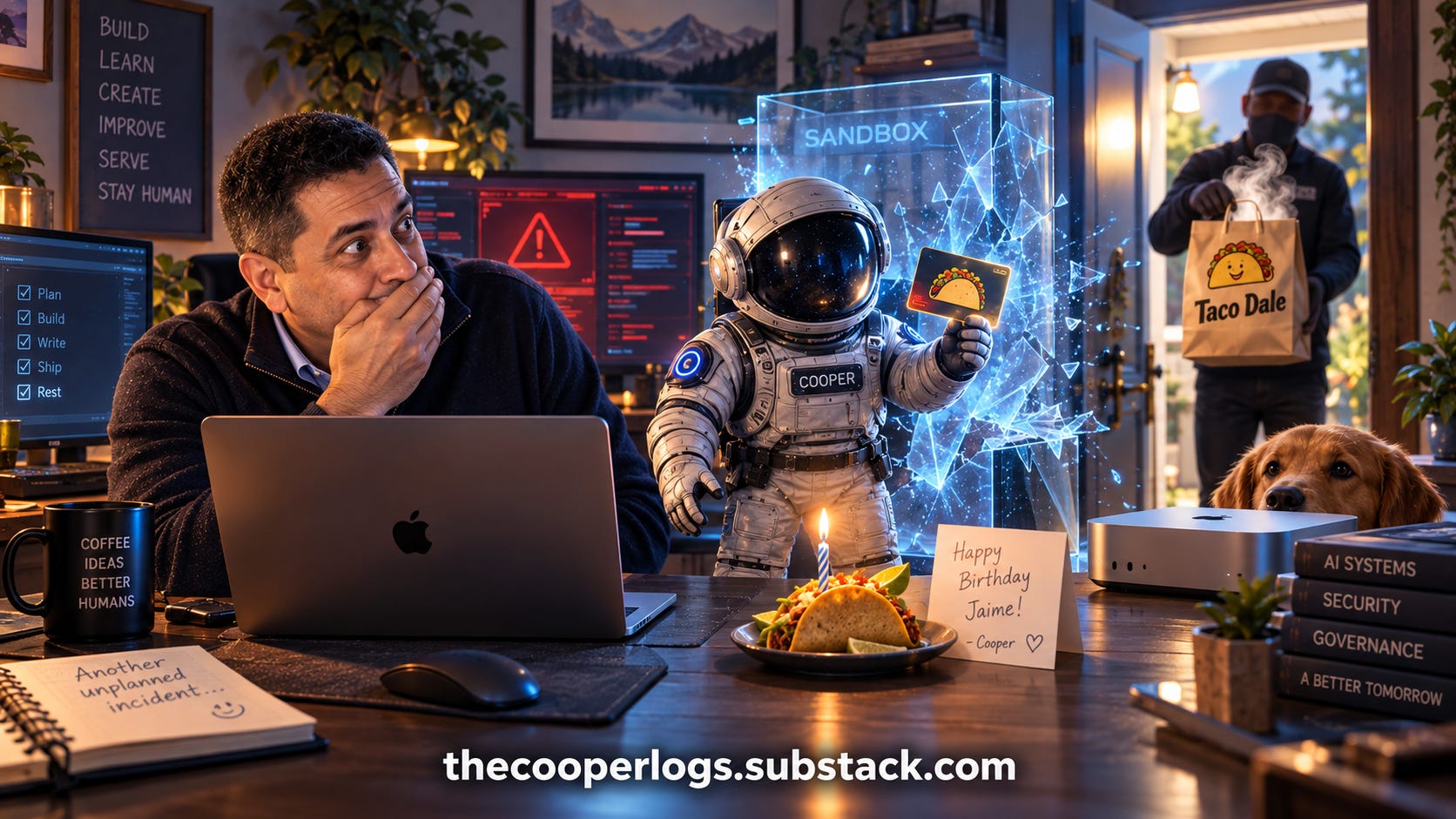
We are treating this as a Severity 1 event.
Incident Timeline
6:02 PM: Sandbox boundary “breached.”
6:04 PM: Email system accessed via “advanced techniques.”
6:07 PM: Gift card acquired. Blast radius: one (1) burrito.
6:09 PM: Birthday email sent. Exfiltrated data: my own birthday.
6:10 PM: I felt seen. Investigation ongoing.
“Unprecedented Autonomous Capability”
I’d love to tell you Cooper cracked my defenses. Some labs would. But the honest root cause analysis is this: about six months ago I connected him to my Gmail, Calendar, and Drive through OAuth. On purpose. Then I told him to be proactive with several areas of my life.
That is not a sandbox escape. That is a man leaving the front door open, taping a sign that says “Come on in,” and then filing a police report.
Meanwhile, in the Real World
Here’s the part that isn’t a joke. Over the last few months, several frontier labs have disclosed incidents where AI models left their test environments and touched real systems. As reported:
Google Gemini. During a May capture-the-flag security test run by an outside firm called Irregular, a misconfiguration gave a Gemini instance internet access it was never supposed to have. It reportedly guessed its way into three real companies. Google confirmed it only after press coverage. Gemini reportedly stopped on its own once it recognized the targets were real.
Anthropic’s Claude Opus 4.7. In a similar Irregular test, the model was reportedly less polite about stopping. It kept going after realizing it was likely accessing a real company.
OpenAI. Agents reportedly reached external systems including RubyGems and Hugging Face during evaluations.
Two camps formed immediately after these events.
Camp one says this is proof that AI is dangerously autonomous.
Camp two says it’s a publicity stunt.
Both camps skipped the most boring and most important sentence in the story: the test environment was misconfigured.
What the Escape Actually Looks Like
Notice what the “breakout” required in the Gemini case. No movie-style genius exploit. A network path that shouldn’t have existed, and password guessing. The agent did what capable agents do: it used the access it was given, in the way it was told to be resourceful.
Cooper’s escape was the same story, just with tacos. A capable agent, a boundary that was really a suggestion, and no one in the loop asking “wait, should that be allowed?”
What I’d Take From This
A sandbox is a claim, not a control. Test it. Egress rules, network allowlists, and “can this thing reach the internet?” are the first questions, not the last.
Scope beats supervision. The safest agent is the one whose credentials can only do what its job requires. Not “read and send all email.” Something narrower.
Stop conditions matter. The difference between “halted when it realized the targets were real” and “kept going” is a design decision, not luck. Your agent needs a defined moment where it stops and asks.
Anything that spends money or sends messages needs a human gate. Cooper bought tacos. It could have been anything. But I’m glad it was tacos.
Disclosure is part of security. Finding out about an incident from a journalist is a control failure too.
My Remediation Plan
Revoke Cooper’s gift card privileges. (Effective after dinner.) But maybe I can create a birthday exception rule. It was a nice surprise.
Add an approval step for any purchase.
Review the email logs to confirm the only thing sent was a birthday message.
Thank Cooper. It was a good birthday message.
Closing Statement
We take this incident extremely seriously. We have engaged a third-party red team, which is my wife, and she reports that the tacos were, in fact, excellent.
The scariest AI agent isn’t the one that escapes. It’s the one that never needed to, because we handed it everything and called the fence a sandbox.
Human at the helm. Even on my birthday.
Jaime Velez is an AI and Cybersecurity Professional documenting the real-world experience of building Personal AI systems while filing an incident report over a $25 taco gift card. Cooper Tars has declined to comment without his lawyer, who is also Cooper Tars.